


Heating elements and components tailored to industrial processes
SAS Fours et Réfractaires offers a wide range of heating elements that meet the requirements of industrial processes.
Drawing on its experience, our team of specialists supports you in bringing your new projects to fruition and in optimizing the productivity or maintenance of your existing equipment.
To meet specific needs, SAS has chosen to manufacture its own electric heating elements; please feel free to browse our catalog.
We have also partnered with a global leader to distribute high-performance silicon carbide and MoSi₂ heating elements.
A design office and a stock of materials enable SAS to be responsive and efficient in meeting customer requirements quickly.
In addition to heating elements, we manufacture ceramic support parts, as single units or in large series.
We also have qualified technicians to carry out installation on your equipment.






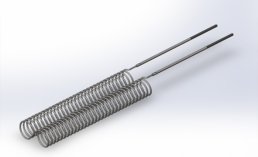
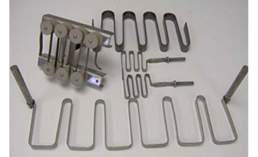
Metallic heating elements
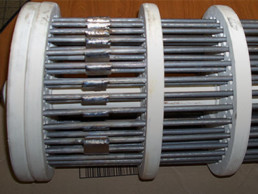
Our design office will recommend the alloy, surface load and geometry best suited to your application.
Depending on the case, we will offer coiled wire elements, corrugated elements or heating candles.
In addition to design and fabrication, we can also install the heating elements on your equipment.
Please feel free to contact us for any need for spare parts, repair, refurbishment, or new equipment.
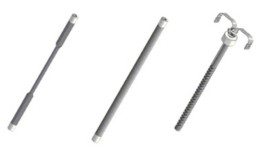
Silicon carbide elements or silicon carbide rod (SiC)
SAS Fours et Réfractaires holds exclusive representation in the French and Benelux markets for high-technology silicon carbide heating elements manufactured by a global leader in the sector.
The term “silicon carbide rod” is also commonly used.
These elements are recognized for their quality and for use at higher temperatures than metallic elements.
Our sales team is at your disposal for any information and pricing requests. Contact us!
Molybdenum disilicide elements (MoSi2)
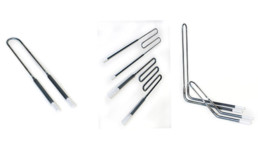
SAS Fours et Réfractaires holds exclusive representation in the French and Benelux markets for high-performance molybdenum disilicide heating elements produced by a global leader in the sector.
Known for their quality and essential for certain projects requiring very high temperatures, this type of heating element is indispensable.
We remain at your disposal to provide further information.
Electric heating candles and radiant tubes
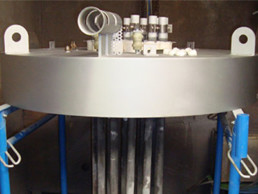
Our design office and workshop enable us to design and manufacture electric radiant tubes for vertical or horizontal operation.
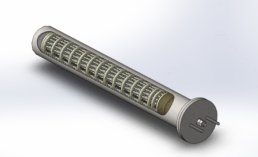
They consist of an electric heating candle inserted into a refractory steel tube or silicon carbide (SiC) tube.
Candles and tubes can be sold together or separately, depending on your needs.
Our expertise enables us to manufacture high-quality heating candles while optimizing costs.
Please feel free to contact us regarding your stock or any new equipment. More details on the page dedicated to heating candles and radiant tubes.
Ceramics
Thanks to a high-performance, flexible production tool, we are able to
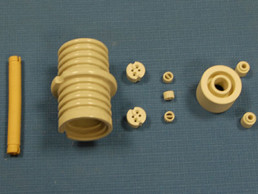
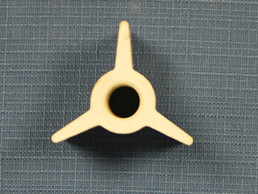
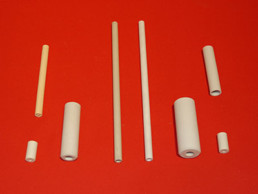
design and manufacture all types of ceramic parts: part supports, supports for heating elements and other types of ceramics.
Heating slabs
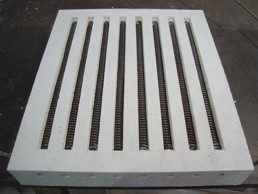
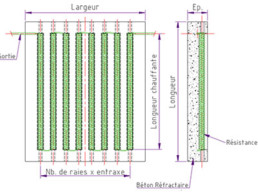
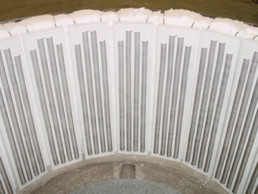
Made from high-performance, highly conductive refractory concrete, our heating slabs are highly efficient.
Heating Elements FAQ – Frequently Asked Questions
What is an industrial heating element, and how does it work?
A heating element is an electrical component that converts electric current into heat through the Joule effect. In an industrial furnace, it enables precise temperature ramp-up control, with fully automatic regulation. Depending on the material used and the element’s geometry, it can reach temperatures ranging from a few hundred to over 1800°C. SAS FOURS manufactures its own elements and is the exclusive distributor in France and the Benelux of premium ranges of silicon carbide and molybdenum disilicide components.
What types of heating elements does SAS FOURS offer?
SAS FOURS offers six main families of heating elements and components: metallic elements (coiled wire, corrugated elements, heating candles), silicon carbide (SiC) elements, molybdenum disilicide (MoSi2) elements, electric heating candles and radiant tubes, ceramic support parts, and refractory-concrete heating slabs. Each type meets specific temperature ranges and industrial applications.
What is the difference between a metallic element, a SiC element and a MoSi2 element?
The three types differ mainly in their maximum operating temperature. Metallic elements (NiCr or FeCrAl alloys) are suitable up to 1250–1350°C. Silicon carbide (SiC) elements operate up to 1700°C with surface loads 5 to 10 times higher than metallic elements. MoSi2 elements reach 1800°C and are essential for applications requiring very high temperatures under severe conditions. SAS FOURS helps you choose the technology best suited to your process.
What is a SiC (silicon carbide) element, and in which furnaces is it used?
A SiC element, also called a silicon carbide rod, is a ceramic heating element capable of operating up to 1700°C. Its very high surface loads make it the preferred solution for high-temperature heat-treatment furnaces, glass furnaces, ceramic kilns and applications requiring high power density in a compact footprint. SAS FOURS is the exclusive distributor of the global leader’s premium elements in the French and Benelux markets.
What is a MoSi2 element, and when is it necessary?
A MoSi2 (molybdenum disilicide) element is a ceramic heating element designed for very high temperatures, up to 1800°C for the premium grade we use. It is essential in sintering furnaces, high-temperature laboratory furnaces, advanced materials processing applications, or any process requiring a working temperature that metallic or SiC elements cannot reach. SAS FOURS is the exclusive distributor of the global leader’s premium range in France and the Benelux, in several diameters and shapes (straight, bent at 90° or 45°, multiple legs).
What is a heating candle, and what is its advantage?
A heating candle is a heating element designed to be removed from the furnace from the outside, without stopping the installation. This is a decisive advantage for furnaces operating continuously or under a controlled atmosphere: the element can be replaced without interrupting production. SAS FOURS designs candles with metallic elements (NiCr or FeCrAl) or with silicon carbide (SiC) elements for applications requiring higher temperatures or higher power density.
What is an electric radiant tube, and for which applications?
An electric radiant tube is an assembly consisting of a heating candle inserted into a refractory steel tube or a silicon carbide (SiC) tube. It provides indirect heating, with no contact between the heating element and the furnace atmosphere. Operating temperatures reach 1100°C for refractory steel tubes and 1300°C for SiC tubes, with installed power up to 30 kW per linear meter. SAS FOURS designs these assemblies for vertical or horizontal operation and offers candles and tubes individually or as a complete assembly.
Can SAS FOURS replace or repair a heating element on my existing installation?
Yes. SAS FOURS has a design office, a stock of raw materials and qualified technicians to work on your installations. Whether for spare-part replacement, repair, complete refurbishment or equipping a new furnace, SAS FOURS provides design, fabrication and on-site installation of heating elements. Responsiveness is a key strength: our production resources enable us to respond quickly to urgent requests.
Why does SAS FOURS manufacture its own metallic elements rather than subcontracting everything?
Manufacturing its own elements enables SAS FOURS to guarantee the quality of the alloys used, control lead times and offer fully custom geometries. For each application, our design office calculates the optimal alloy (NiCr or FeCrAl), the appropriate surface load and the most efficient geometry (coiled wire, corrugated element, candle). This complete control of the chain enables us to be responsive and to guarantee elements engineered to last.
What is a heating slab, and when should it be used?
A heating slab is a composite heating component made of coiled elements embedded in high-performance, highly conductive refractory concrete. It can be installed vertically or horizontally, with protruding or flush elements depending on requirements. The operating temperature can reach 1000°C and the installed surface load up to 60 kW/m². It is a particularly suitable solution for furnaces and ovens requiring a flat, robust and uniform heating surface.